

In 2022, most of us had never heard of ChatGPT. By 2023, it was a household name. By 2024, it wasn’t just ChatGPT anymore, as AI-powered tools were everywhere, generating images, building presentations, and writing code. It’s 2026, and AI isn’t a trend educators are watching from a distance. It’s already sitting in every classroom, reshaping what it means to learn, work, and think.
Employers across industries are asking for the same thing: adaptability, critical thinking, problem solving, and the ability to work through uncertainty without shutting down. These aren’t technical skills. They are skills that are developed through experience, grappling with real problems, making decisions, and figuring out what to do when the path forward isn’t clear. This is our instructional design challenge that belongs in every classroom, at every grade level, in every content area.
Durable Skills: What AI Can’t Replicate
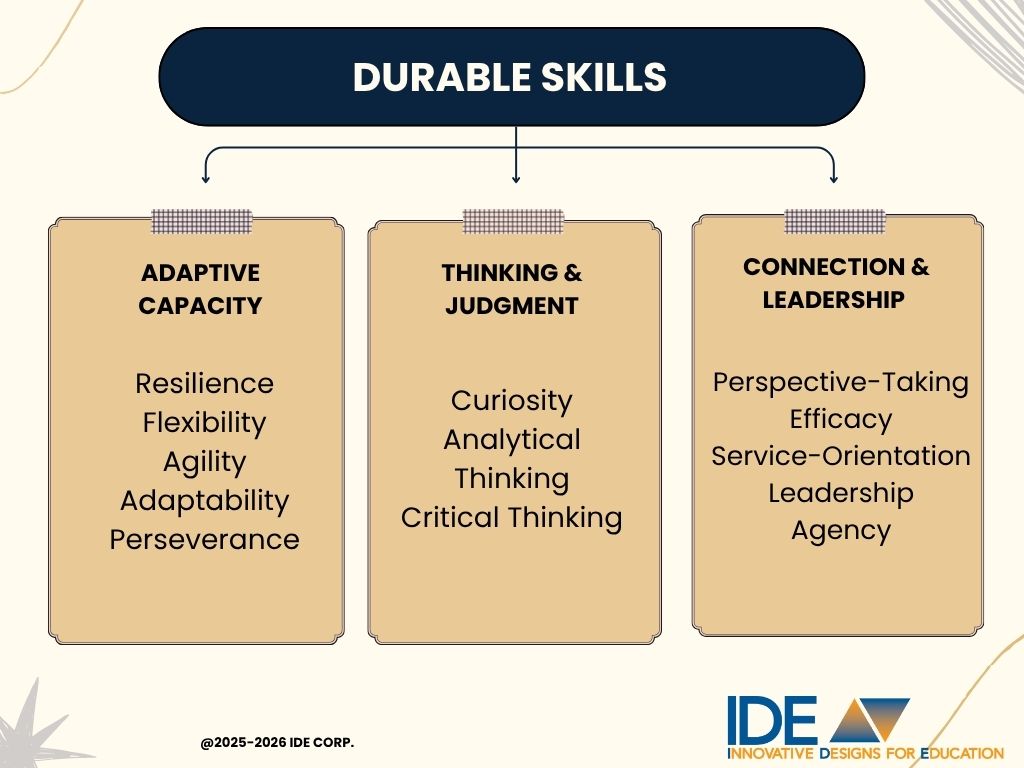
In her blog last year, Dr. Nancy Sulla wrote about durable skills. These skills stand the test of time, transfer across jobs and life circumstances, and cannot be outsourced to AI. This year, I organized those skills into three categories: Adaptive Capacity, Thinking and Judgment, and Connection and Leadership.
Notice what’s missing from this list: any skill that AI can replicate.
AI can produce the work. . . . It cannot care whether the work was meaningful.
AI can build the argument. . . . It cannot be held accountable for its impact.
AI can generate a project idea. . . . It cannot feel the weight of the community it affects.
That human advantage, what students can bring that AI cannot, is where the durable skills live, and these skills only develop when students are engaged in learning experiences that require them.
The quick evolution of AI has made the skills gap impossible to ignore. Classrooms focused primarily on content delivery will struggle to build durable skills in students because these skills are developed through experiences, not just instruction. When a learning experience is designed with durable skills as an intentional target, everything shifts.
Designing Classrooms That Prepare Students for What Comes Next
- • Students work on solving meaningful, real-world problems that don’t have a single right answer. They make decisions, hit obstacles, collaborate, and figure out how to move forward.
- • Students use a rubric to determine expectations and skills/content they need to learn; they use a differentiated activity list to determine how they want to learn a skill/content and schedule when and with whom they will work. This builds student agency and a host of durable skills.
- • The teacher facilitates by asking questions that push thinking more deeply and by creating structures that develop student agency over time. The content is the vehicle, and the skill development is the destination. This is the difference between a classroom where durable skills happen by accident and one where they are the intentional target. It comes down to design and facilitation.
AI will continue to advance; that much we know for sure. The workforce AI is reshaping won’t wait. The opportunity is ours to design classrooms where students don’t just consume content but develop the skills, the judgment, and the humanity that no technology will ever replace.
IDE Corp. has spent decades helping educators build exactly this. Future-Powered Classrooms build academic, durable, executive function, social, emotional, and mental wellness skills — all in one immersive learning environment!
Explore our online, full-school professional learning experiences intended to build a culture of professional learning at a time all schools need to shift thinking!
Consider our online Virtual Learning Communities: five-week courses focusing on key skills for the future.
Looking for a more comprehensive consulting solution to transform instruction in your school/district? Contact us at solutions@idecorp.com