

What’s with the Tiers?
Tier 1 is the instruction every student gets, every day. It has to be designed to work for a room full of students with different backgrounds, different language levels, different prior knowledge, different cognitive abilities, and different readiness . . . all at once.
That’s a tall order, and it’s also the whole point: Get Tier 1 strong enough, and you need Tier 2 and Tier 3 far less often.
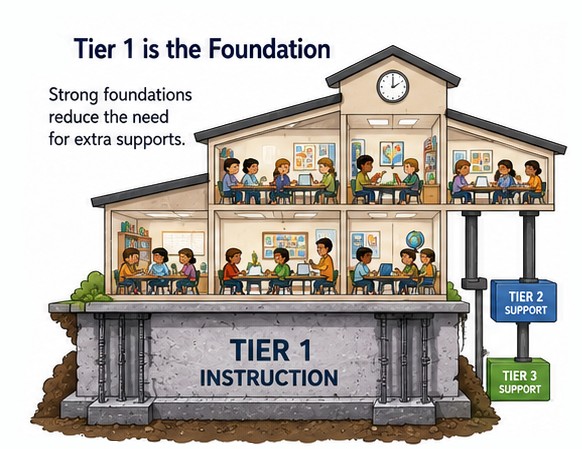
I want to make a distinction up front, because it changes how you think about the whole framework: The tiers were never meant to label students. They describe what educators need to do to provide appropriate intervention through the level of instructional support a student needs on a given skill, right now. Students who are provided with Tier 2 instruction for understanding the concept of fractions aren’t “Tier 2 students.” They’re students who needs a bit more targeted support on one specific skill or concept, with the explicit goal of getting them back into Tier 1 successfully.
Personalization Powers the Elevation of Tier 1 Instruction
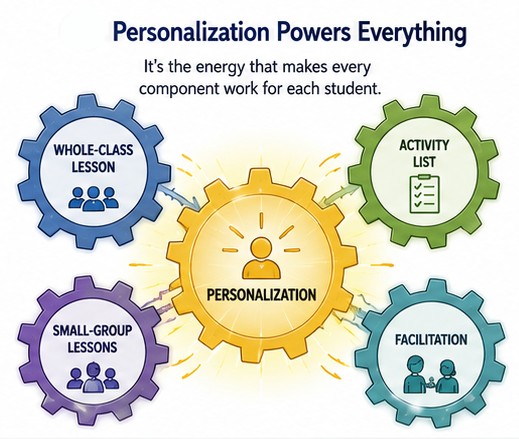
Here’s a distinction worth making explicit: Personalization isn’t one more piece sitting next to the structures that make up Tier 1 instruction. It’s what elevates those structures from adequate to powerful. You can build an activity list, run small groups, or offer a whole-class lesson without much personalization in any of it … and it’ll be flat. Personalization is the quality that makes each of those pieces actually meet the student in front of you.
And it shows up in two different places:
Instructional design — the up-front work of building activity lists, small-group structures, and benchmark lessons with real variation baked in from the start
Facilitation — the in-the-moment work of how you actually talk to a student, adjust an explanation on the fly, or decide which question to ask based on what you know about them. No amount of well-designed structure replaces this. It’s where a teacher’s judgment and relationship with the student does the real work.
A note on scripted curricula: A lot of teachers today aren’t designing lessons from scratch. They’re handed a scripted teacher’s guide and told to follow it. That doesn’t take personalization off the table; it changes where the work happens. Instead of creating original activities, the teacher simply sorts what’s already in the guide: This piece becomes a small-group mini-lesson, this piece goes on the activity list, this piece works as a whole-class hook. The content stays the same. What changes is how it’s placed and delivered.
The Four Components of Elevated Tier 1 Instruction
Elevated Tier 1 instruction isn’t one lesson — it’s four distinct pieces working together, each doing a job the others can’t.
1. The whole-class motivating lesson. This is a short, focused lesson to the whole class, but its job isn’t to teach content. A lesson that tries to directly teach a skill to every student at once can’t be personalized; it’s built for an average student who doesn’t exist. Instead, this lesson’s job is to spark interest and trigger awareness of what students are about to need, creating a felt need for it. Best kept short and focused, this lesson sets up everything that follows.
2. The differentiated activity list. This is where the actual content learning happens, built from five types of activities: learning (introducing something new, with feedback built in), practice (spaced and varied retrieval of what’s already been learned), application (using the learning in a bigger, authentic problem), assessment (students self-checking where they stand), and reflection (pausing to think about the learning itself, not just checking a box). These activities show up as self-directed formats students can work through independently: how-to sheets, how-to videos, learning centers, instructional videos, reading passages, podcasts, interactive web pages, peer expert sessions. The point isn’t the format; it’s that each activity works without you, as the teacher, standing over it.
3. Opportunities to attend small-group lessons. As students move through their activity list, some will need — or choose — a small-group mini-lesson with you. This is targeted, short, and based on what a specific cluster of students needs right now, not a repeat of the whole-class lesson.
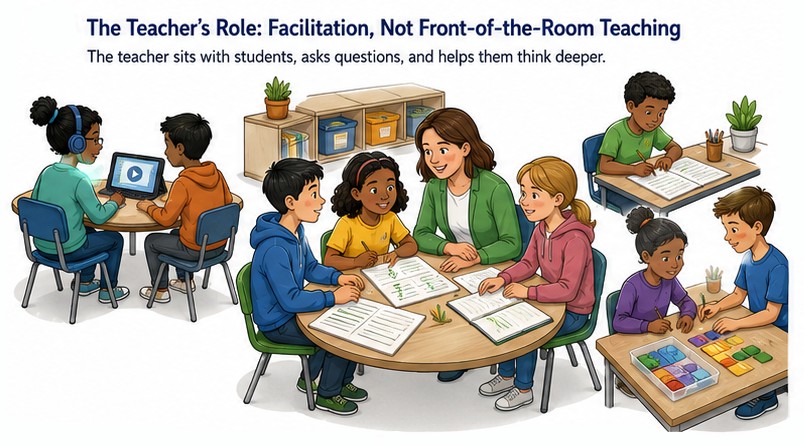
4. Facilitation. While students are making choices and taking action, the teacher isn’t front-of-room lecturing. They’re circulating, checking in, pulling small groups, and making in-the-moment decisions about who needs what. This is where personalization actually gets delivered, student by student.
What Elevated Tier 1 Instruction Looks Like in the Classroom
Picture a math unit built this way. After a short benchmark lesson sparks interest in the upcoming skill, students take a short pretest: just a handful of questions per key skill; students score it themselves.
From there, the path splits naturally:
- Correctly answer every question on a skill? Move to a challenge activity.
- Get most of it right? Work through a couple of practice activities.
- Still shaky? Head into a learning activity (a video, how-to sheet, peer expert session) or a small-group mini-lesson.
- Not remember the skill? Start with introductory, foundational activities.
This way, the teacher isn’t standing at the front repeating the same lesson to 25 kids in 25 different progress levels. They’re circulating, pulling small groups, facilitating — doing the highest-value thing they can do in the room at any given moment.
Here’s the payoff: This is Tier 1, Tier 2, and even Tier 3 all happening in the same room, at the same time, without a single student being pulled out or labeled. A student getting a small-group mini-lesson today isn’t receiving Tier 2 instruction; they’re getting exactly the support this skill requires. Tomorrow, on a different skill, that same student might be the working ahead on a challenge activity.
This is what it means to build tiers into your teaching, rather than into your students.
The Bigger Shift
Strong Tier 1 instruction takes more up-front work than a single scripted lesson plan. But once the structures are built — the benchmark lessons, the activity lists, the small-group routines — they run themselves, year after year, with far less effort than you’d think. And the payoff compounds: Fewer students need to be pulled aside, fewer students get quietly sorted into a label, and more students spend their time getting exactly the instruction they need, right when they need it.
That’s the real goal of tiered instruction: not to sort kids by ability, but to make sure every layer of support is doing exactly the job it’s meant to do, starting with the strongest possible foundation at Tier 1.
IDE Corp. partners with school districts to bring about transformational change. For elevating tier 1 instruction, we offer:
- • Our school-wide, online, professional learning experience: “Fostering Student Agency Through Differentiated Activity Lists.” Broaden your learning opportunities during Tier 1 instruction; engage full faculty in discussions and professional learning; build a culture of professional learning in a school
- • Our individual Virtual Learning Communities (5-week self-directed learning w/ a consultant coach)
- • On-site or remote professional learning with a consultant – contact solutions@idecorp.com or call 201-788-4222