

Whether your students spend the day with you in an elementary classroom, rotate through periods, or move through 80-minute blocks, the question is the same: Is every minute actually working for learning?
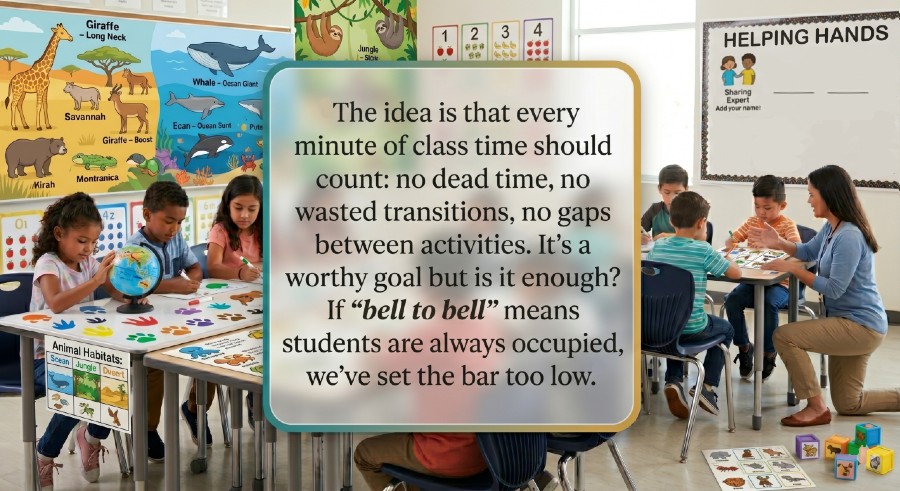
“Bell to bell.” You’ve heard it. Maybe you’ve said it. The idea is that every minute of class time should count: no dead time, no wasted transitions, no gaps between activities. It’s a worthy goal, but is it enough? If “bell to bell” means students are always occupied, we’ve set the bar too low.
What if every minute meant students were engaged in learning? Not waiting for the teacher to start them. Not sitting through content they already know. Not lost while the teacher works with someone else. Actually learning: engaged with content that’s appropriately challenging, moving at a pace that works for them, and owning their progress. That’s a different picture. And getting there requires rethinking how you design time itself.
Time Is Your Most Valuable Resource: Design It Intentionally
Here’s the reality about a 45-minute period, an 80-minute block, or any amount of class time: It doesn’t automatically produce learning. The clock running doesn’t mean minds are working.
Most teachers design lessons; the best teachers design learning experiences. The difference? A lesson is built around what the teacher will do. A learning experience is built around what students will encounter, grapple with, and discover.
That shift starts with the opening minute.

Capitalize on the Opening
Walk into most classrooms and the first several minutes look like this: Students settle, teacher takes attendance, a “do now” gets projected, some students do it, others wait to copy it when time’s up. The lesson hasn’t really started yet — but 3 to 5 minutes are already gone. Even just 3 minutes for 180 school days = 9 hours of wasted time. At the secondary level, multiply that by 7 classes, and you’ve lost more than a week of school.
What if students walked in and they knew what to do?
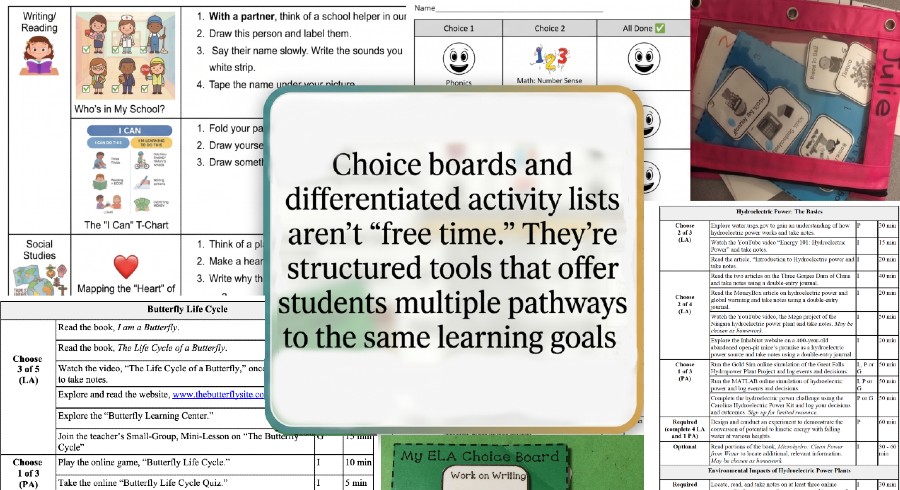
Primary: A choice board offers options of activities and centers from which to choose. Students number 3 choices in order and get started.
For older students: A differentiated activity list offering daily or weekly choices allows students to schedule their time as to when and how they will learn. If you give homework, offer a self-check and small-group help time.
For all: PBL! A clear, real-world problem or challenge that students are working on will motivate them to enter and dive into learning. Position students to walk in and get to work because the environment invites them to. And it works whether your students are 4 or 14 or 40.
The teacher’s job in that first 5 minutes? Facilitate, not manage. Move through the room; observe students in action; redirect students who may be unfocused; ask questions; check in.
Rethink the Lesson as a Learning Experience
Whether you teach in a 45-minute period or a 80-minute block, IDE’s O-M-E framework offers a powerful redesign of instructional time:
Opening: Hook students with why the content matters: a real-world problem, a compelling statistic, a scenario that puts the content in context. This is your 10- to 15-minute keynote — not a lecture, but an invitation. Make them curious before they dig in.
Middle: Give students agency over how they engage. A differentiated activity list with options — video, text, hands-on, discussion, digital exploration — lets students map out their own path through the content. Small-group instruction can happen here for students who need more direct teaching, while others work independently.
End: Synthesize together. What did students discover? What questions emerged? Because students grappled with the content before the whole-group discussion, more of them are ready to participate — they’ve processed, so they can contribute.
This works in any schedule. The opening and end bookend the middle; the middle is where real learning happens at the student’s pace. For more on block scheduling, read my blog post “Two Approaches to Teaching in the Block.”
Student Agency Is the Key to Using Time Well
Here’s what the research and classroom experience confirms: When students have agency over their learning, engagement goes up, deeper understanding follows, and yes, time is used better. (https://pmc.ncbi.nlm.nih.gov/articles/PMC11836230; https://www.rti.org/insights/the-power-of-student-agency-and-choice)
Choice boards and differentiated activity lists aren’t “free time.” They’re structured tools that offer students multiple pathways to the same learning goals. Every option connects to your standards. The difference is that students choose what fits them based on their current level, their learning style, their interest.
When students have a plan for the class period, such as, a checklist or a schedule they’ve mapped out themselves, they don’t need you to manage their minutes. They manage their own. And that’s a skill that extends far beyond your classroom. Those are the durable skills that depend on executive function … the building blocks of all learning!
The Bottom Line
Bell to bell isn’t about filling time; it’s about designing time: intentionally, purposefully, and with the learner at the center. Whether you start with a sharper opening, introduce a differentiated activity list, or move toward full project-based learning, the shifts are the same:
Move from teaching lessons to providing learning experiences.
Move from presenting content to facilitating learning.
Make every minute count by shifting toward greater student agency . . . putting students in charge of their own learning.
At IDE Corp., WE KNOW LEARNING!
We can help you infuse building executive function into your curriculum and instructional practices through district-wide, school-wide, or cohort-based design and professional learning. We also offer related online engagement through:
- – Whole-school engagement in our Professional Learning Experience (PLE) resources on “Fostering Student Agency Through Differentiated Activity Lists” and other titles.
- – Individual Virtual Learning Community (VLC) courses on “Designing Differentiated Activity Lists,” “Structures to Support Individualized Learning,” and more. Upcoming summer and fall schedules!
Contact us at solutions@idecorp.com or 201-934-5005.