


IDE Corp.’s Director of Learning Design
It’s the Screens! Or Is it?
Screen time has become the villain in most conversations about young children’s attention, behavior, and learning.
Kids can’t focus? Screens!
Kids can’t regulate emotions? Screens!
Kids don’t reason the way they used to? Screens!
Technology does play a role. But blaming screens alone lets the rest of the system completely off the hook.
Because long before tablets entered classrooms and homes, we quietly removed something else that is essential to brain development: meaningful movement, physical risk, and spatial challenge.
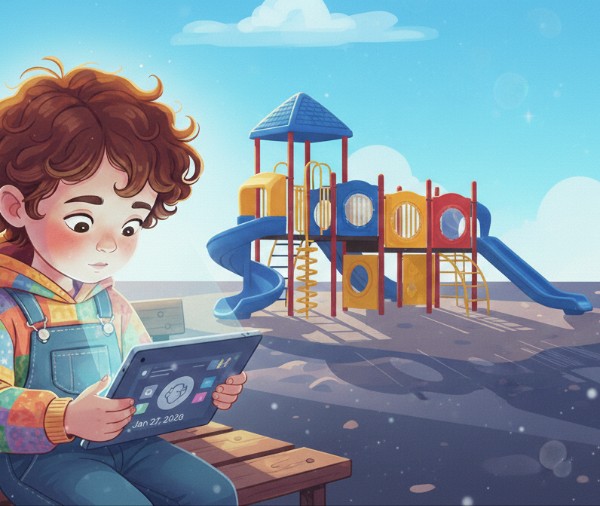
What We Lost When Playgrounds Got Safer
If you grew up before the 2000s, your nervous system was shaped by experiences that made your stomach drop and your heart race: high swings, fast merry-go-rounds, climbing higher than you intended and figuring out how to get back down, and hot metal slides in August.
Those experiences were not just fun. They were neurological training.
They challenged balance, coordination, spatial awareness, and emotional regulation. They required you to assess risk, adjust your body in space, recover from disorientation, and persist through discomfort.
In other words, they developed the vestibular system.
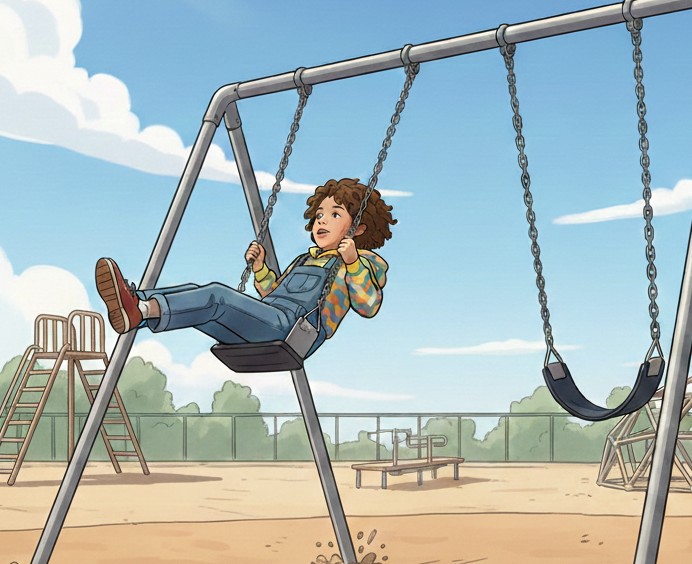
Why the Vestibular System Matters for Learning and Behavior
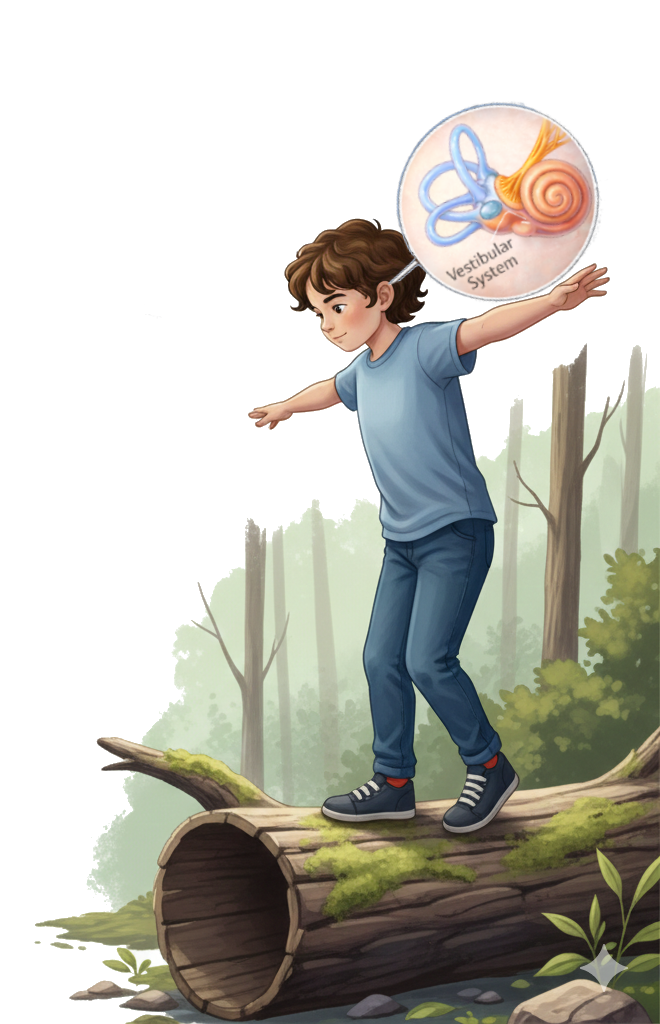
The vestibular system, located in the inner ear, plays a central role in balance, spatial orientation, and the brain’s ability to coordinate movement, attention, and emotional regulation. It helps children understand where their body is in space, shift attention, regulate anxiety, and prepare the brain for learning.
When the vestibular system is underdeveloped, children may struggle with focus, emotional regulation, spatial reasoning, and even confidence in navigating their environment. These challenges often show up as behaviors long before they are recognized as sensory or regulatory needs.
Today’s playgrounds are undeniably safer. They are softer, lower, and more predictable.
That has reduced injuries. It has also dramatically reduced daily opportunities for children to challenge their balance and spatial awareness in meaningful ways.
Why We Mislabel Regulation Challenges as Behavior Problems
Because vestibular challenges are invisible, adults tend to default to familiar explanations when children struggle.
We assume:
- – They need to try harder.
- – They are seeking attention.
- – They are anxious or oppositional.
- – They need tighter structure or stronger consequences.
- – They need less screen time.
But a growing body of research suggests a different explanation.
Recent studies have found a strong link between vestibular dysfunction and attention-related challenges, including ADHD. In one study, a significant percentage of children diagnosed with ADHD showed vestibular hypofunction, while typically developing peers did not. Many of those children also experienced a combination of imbalance, anxiety, and spatial disorientation, all tied to vestibular processing.
What we often label as inattention, anxiety, or defiance may actually be a regulation and sensory-processing challenge rooted in missed developmental experiences.
Why “Movement Breaks” Are Not Enough
Even when children appear active today, they are often being moved rather than choosing movement. They are directed rather than navigating. They are supervised rather than problem solving independently.
This is where schools often get stuck.
We notice dysregulation or lack of focus and respond with a movement break, a fidget, a checklist, or a stand-alone executive function lesson. Each strategy may help momentarily, but isolated interventions do not repair systemic gaps.
You cannot rebuild vestibular development with a two-minute brain break.
You cannot strengthen reasoning through constant adult direction.
You cannot expect teachers to shoulder neurological development on top of everything else they already do.
This is not a child problem.
This is not a teacher problem.
This is not a screen problem.
It is a systems problem.
What Young Children Actually Need Instead
The answer is not a return to unsafe playgrounds or reckless risk. The goal is to design modern learning environments that intentionally restore what has been lost.
Young children need:
- – Daily opportunities for varied, meaningful movement
- – Safe risk-taking that requires judgment and adjustment
- – Spatial reasoning through play and exploration
- – Guided autonomy rather than constant adult control
- – Time to recalibrate when their body or emotions feel off
Instead of asking, “How do we reduce screen time?” we should be asking, “What experiences are screens replacing, and how do we rebuild those experiences intentionally?”
Rebuilding What’s Been Lost: The Learner-Active Classroom
A Learner-Active, Technology-Infused Classroom is one way schools can intentionally rebuild these foundational experiences without returning to unsafe equipment or placing an additional burden on individual teachers.
In Learner-Active Classrooms:
- – Children use activity lists to plan and manage their time.
- – Students know where to go, what to use, and how to get started without waiting for adult direction, even in kindergarten.
- – Adults ask questions that prompt thinking, choice, and explanation. (Check out our five levels of facilitation questions: primary, elementary, secondary)
- – Students are allowed to engage in productive struggle rather than immediately rescued.
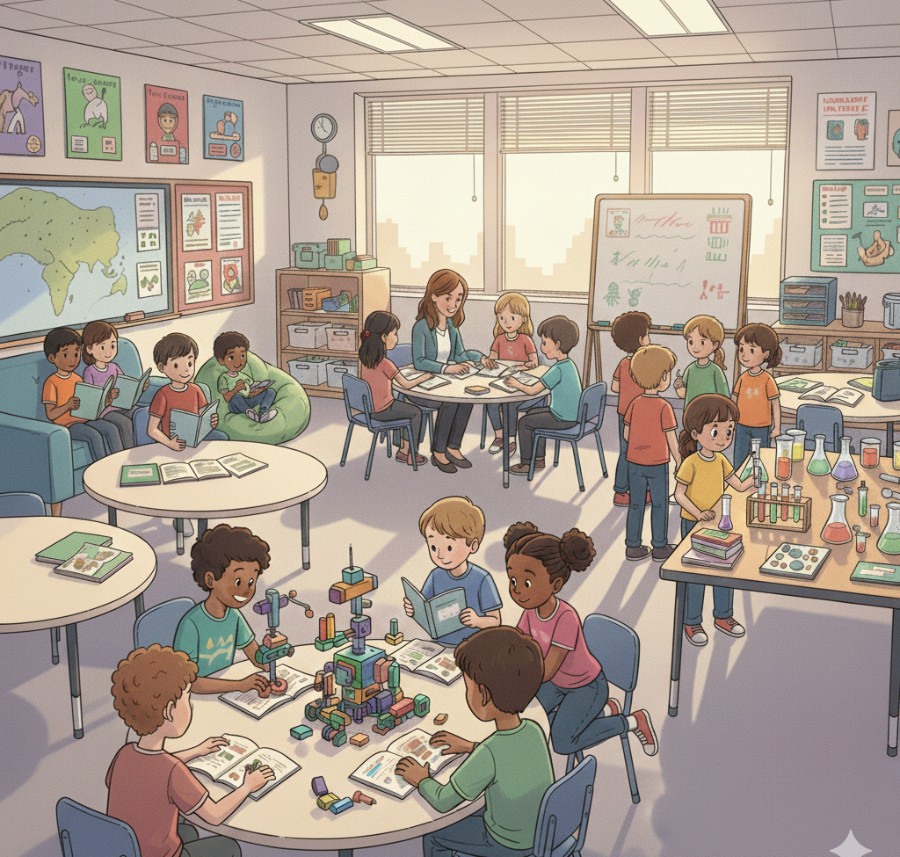
Instead of layering on isolated interventions, the environment and instructional flow are redesigned so vestibular input, spatial reasoning, and self-regulation are woven naturally into the day.
Over time, balance, spatial awareness, and regulation are strengthened through consistent daily experience.
Protecting Children’s Brains, Not Just Their Bodies
Safer playgrounds reduced broken bones. That was a win.
Now it is time to protect children’s brains with the same intentionality.
Attention, regulation, and learning do not develop in isolation. They are built through movement, challenge, autonomy, and experience. When we restore those conditions thoughtfully, young children are better positioned to thrive in school and beyond.
blog content by Holly Hunt; images by ChatGPT and Gemini
IDE Corp. designs Learner-Active, Technology-Infused Classrooms and Future-Powered Kindergarten for schools looking to build executive function, student agency, and strong academic performance. Contact solutions@idecorp.com to discuss ideas for your school.
Our online, on-demand, school-wide professional learning experience in building executive function helps teachers implement activities, structures, and facilitation strategies to build stronger self-regulation and executive function.
For a more course-like approach for individuals, our Virtual Learning Communities offer five-week (or two-week summer) courses on a wide range of related topics, including building executive function.