


IDE Corp.’s Chief Strategy Officer
For many school leaders, faculty meetings have become a necessary frustration. Information must be shared. Updates must be delivered. Time is short. The result is often a meeting built around dissemination: slides, announcements, reminders, and a lingering sense that nothing really changed once everyone left the room.
In Students Taking Charge Implementation Guide for Leaders (download chapter 1 here), one of the most critical mindset shifts for leaders is moving from dissemination to conversation. This shift is not about making meetings more entertaining or adding discussion for discussion’s sake. It is about recognizing that implementation lives in conversation, not in communication alone.
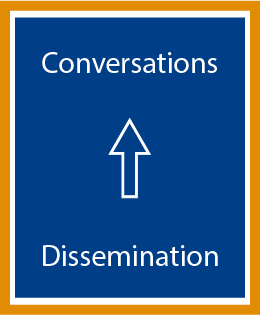
Why Dissemination Falls Short
Dissemination assumes that once information is shared, action will follow. Conversation assumes something more human and more realistic: that people need time and space to process, question, connect, and make meaning together.
When faculty meetings focus primarily on dissemination:
- • Teachers receive information but rarely internalize it
- • New initiatives feel imposed rather than owned
- • Leaders do the cognitive heavy lifting while staff listens
- • Implementation gaps widen quietly over time
Conversation changes the work. It invites educators into the thinking, not just the task.
Conversation as an Implementation Strategy
Leaders who treat faculty meetings as conversation venues use them to surface beliefs, clarify purpose, and align practice. These leaders design meetings around questions such as:
- • What does this look like in our classrooms?
- • What feels challenging about this shift?
- • Where are we already doing this well?
- • What support would make this easier to sustain?
These conversations are not unstructured or inefficient. In fact, they are often more disciplined than traditional meetings because they are anchored to a shared focus and clear outcomes.
Conversation is where all of these things happen:
- • Shared language develops
- • Misalignment or disconnect is surfaced early
- • Confidence grows through collective sense-making
- • Ownership begins to take root
Conversation creates conditions for collective efficacy!
Using Professional Learning Experiences to Elevate the Conversation
One challenge leaders often face is what to anchor the conversation to. Open-ended discussion without a common reference point can drift quickly.
This is where EdQuiddity Inc’s Professional Learning Experiences (PLEs) become a powerful leadership tool.
PLEs are not just content libraries. They are intentionally designed to fuel conversation through different kinds of tools and resources:
- • Insight videos that introduce ideas in accessible, shared language
- • Reflection prompts that ask educators to connect ideas to their own practice
- • Structured discussion activities built directly into the experience
- • Downloadable tools that move talk toward action
Instead of leaders having to invent discussion protocols or summarize research, the PLE provides a common learning artifact that everyone can engage with before or during a meeting.
What This Looks Like in Practice
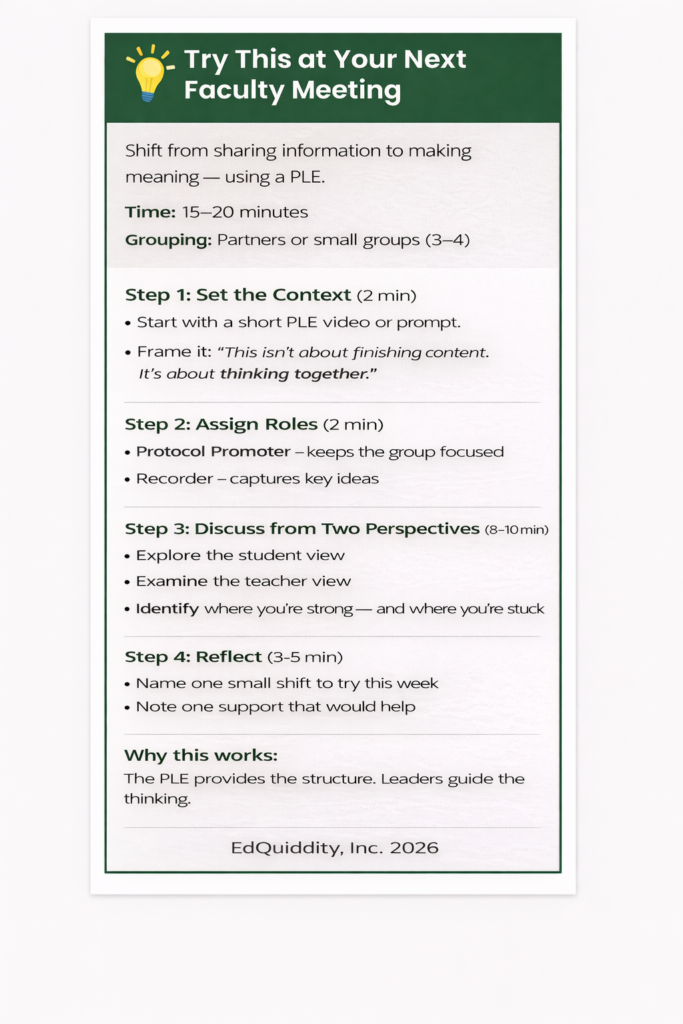
Leaders use PLEs in faculty meetings in simple but intentional ways:
- • Asking staff to engage with a short insight video prior to the meeting, then using the built-in reflection prompts as discussion starters
- • Using a PLE activity during the meeting to guide small-group conversation
- • Anchoring discussion in a shared tool or framework rather than opinions alone
- • Closing meetings with a reflective question that connects learning to next steps
The result is a meeting that feels purposeful, professional, and worth the time.
The Real Shift
The shift from dissemination to conversation is ultimately a shift in how leaders view their role. Instead of being the primary messenger, the leader becomes the designer of conditions where thinking can happen collectively.
When faculty meetings become places where educators think together, wrestle with ideas, and make meaning as a group, professional learning stops feeling like something that happens to teachers and starts becoming something they actively shape.
That is where real change begins, not in what is said, but in the conversations we choose to make possible.
For more information on our PLEs and a complimentary consultation and brainstorming session on transforming professional learning to shift from dissemination to conversation, contact us at solutions@idecorp.com.