

I love math! My favorite subject to teach was Algebra, and I taught it in middle school for several years. If students took Algebra in 7th grade, they likely came from advanced 6th-grade math and had been in advanced math in 5th grade. These students were well-versed in math! However, they were well-versed in math that was largely concrete, and if you know anything about Algebra, it is not. For my middle schoolers, Algebra was their first course to demand a sustained shift to abstract thinking.
I always watched for that light bulb moment in Algebra, when a student’s reasoning finally connected. For some, it happened in 7th grade; for others, it happened in 8th grade, when they took Algebra again. Something was happening in their brains that made abstract thinking reachable.
What Was Happening in Their Brains
Looking back, much of what I saw was the development of the prefrontal cortex (PFC). The prefrontal cortex supports executive function: holding information in mind, planning multi-step work, shifting strategies, and catching our own errors. It develops gradually into early adulthood, and it grows stronger with use.
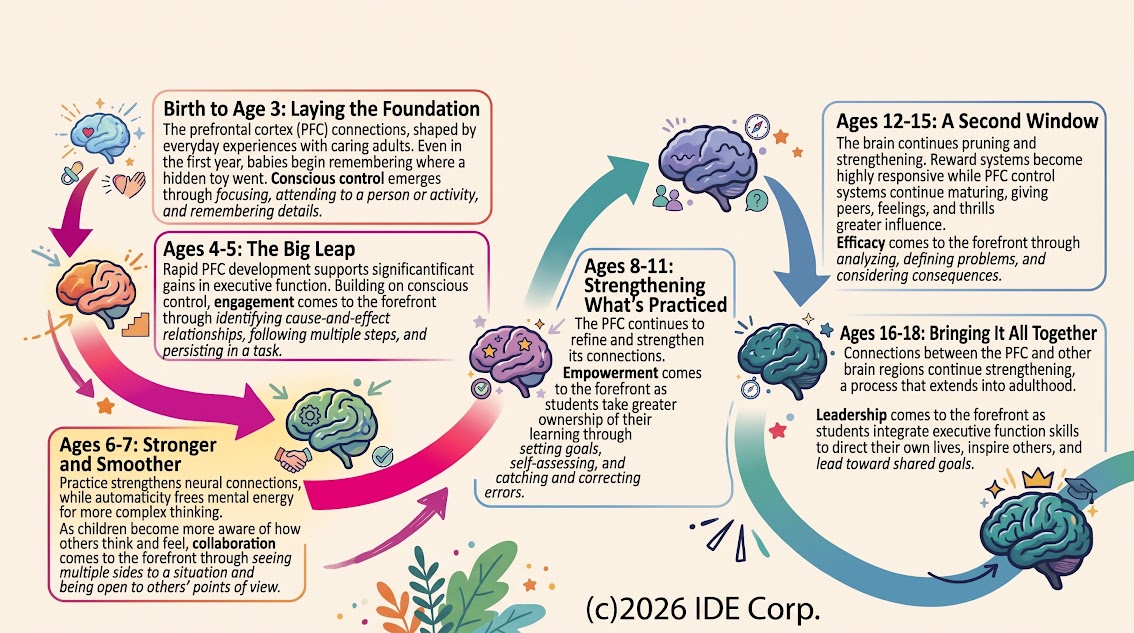
The graphic above traces that development across typical age ranges, though timing varies from child to child. Drawing on Dr. Nancy Sulla’s work in Building Executive Function: The Missing Link to Student Achievement, it highlights a new capacity at each stage: conscious control, engagement, collaboration, empowerment, efficacy, and leadership. These capacities are layered, not linear. Each one keeps growing as the next emerges, and together they build toward leadership, as students learn to direct their own learning.
Where the Light Bulb Comes From

My students’ light bulb moments weren’t something they simply waited for. They were wrestling with Algebra by holding on to information while considering other information, thinking about multiple concepts simultaneously, catching and correcting errors, and more.
All of this was helping build the executive function that made abstract thinking click. The science of PFC development gives us a reason to be intentional about our instructional design. Students’ brains are still developing, and in middle school especially, the brain prunes and strengthens connections based on what students practice, so every learning experience we design is a chance to build executive function on purpose. Some students got there in 7th grade, others in 8th, and neither was less capable. Our role is to keep expectations high and design learning that gives every student the chance to get there.
If your team is exploring how to build executive function into everyday instruction, IDE Corp.’s professional development and EdQuiddity’s Professional Learning Essentials topic on Executive Function offer complementary ways to start.