

Picture yourself walking into a classroom for the first time. You don’t know anyone. You find a seat and look around. Does anyone look like you? Whose images, quotes, and posters are on the walls? Are you greeted with a smile? Will you know how to ask for help when you need it? Will you feel comfortable doing so?
Every student who walks through your classroom door carries some version of that uncertainty. Whether they find their footing early or spend the year just trying to get through it may come down to the choices you made, knowingly or unknowingly, before they arrived. This is why, as educators, you want to lead with intention. Every student brings distinct lived experiences, cultural identities, and ways of knowing shaped by family, community, and background. That diversity is an asset in your classrooms and schools.
The Six Lenses of Instructional Equity
IDE Corp.’s Six Lenses of Instructional Equity are:
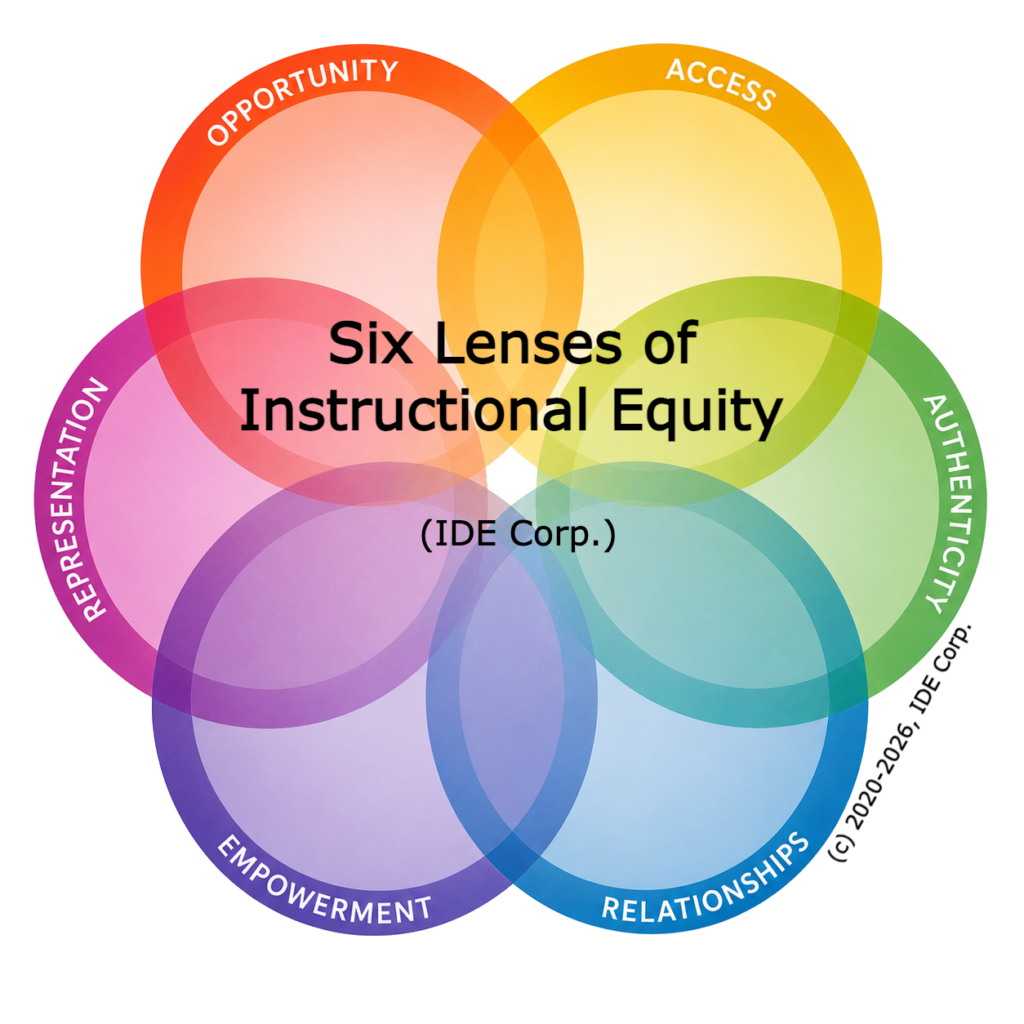
-Opportunity
-Access
-Representation
-Relationships
-Empowerment
-Authenticity
The lenses enhance your work with students in two places:
1. As a curator, you look through these lenses as you design: the questions, materials, structures, choices, and learning experiences.
2. As a facilitator, you look through them in the moment: the move you make when a student is stuck, the question you ask to push thinking further, the conversations you have to get to know each student.
You’re rarely only one or the other. You are constantly switching between the curator and facilitator of your classroom.
Opportunity – Opportunity is the doorway, the invitation for every student to engage, try, and reach higher. Opportunity isn’t distributed evenly by default. Who gets called on, who gets challenged, and who gets steered toward remediation often correlates with disability status, language, gender, and race. Looking through this lens means presuming each student is capable. When a student asks to take on a harder text or a more complex project, you say yes, then build the support to make it possible.
Ask yourself: Does my feedback move every student’s thinking forward? Are leadership roles rotated so every student gets a turn? Who gets the interesting work in my classroom, and who rarely does?
Access – If opportunity is the door, access is the key. A student can be offered an opportunity and still be shut out by a lesson delivered in English without supports, a missing prerequisite skill, or fear of being laughed at. Looking through the lens of access means planning scaffolds before students need them: sentence frames, visual models, vocabulary support, how-to sheets. Then, in the moment, you show students how to use those tools and why they’re beneficial.
Ask yourself: What might stand between this student and the opportunity I’ve offered? Is the content available in more than one way? Do students know the supports that are available and that using them is a strength, not a weakness?
Representation – Rudine Sims Bishop (1990) described literature as mirrors, windows, and sliding glass doors. Mirrors reflect a student’s own identity and lived experience. Windows offer a view into someone else’s. Doors invite a student to step into a perspective that isn’t their own. Representation matters for far more than what’s on the walls, as this passage from our upcoming book explains:
“When a student walks into a room where they feel ‘othered’, whether subtly or overtly, the brain enters a state of vigilance. It scans for safety. It anticipates misunderstanding. It braces for bias. And all of that burns cognitive energy that could otherwise fuel learning, problem-solving, and collaboration. That cognitive tax is invisible to everyone except the student paying it. Representation reduces the tax.”
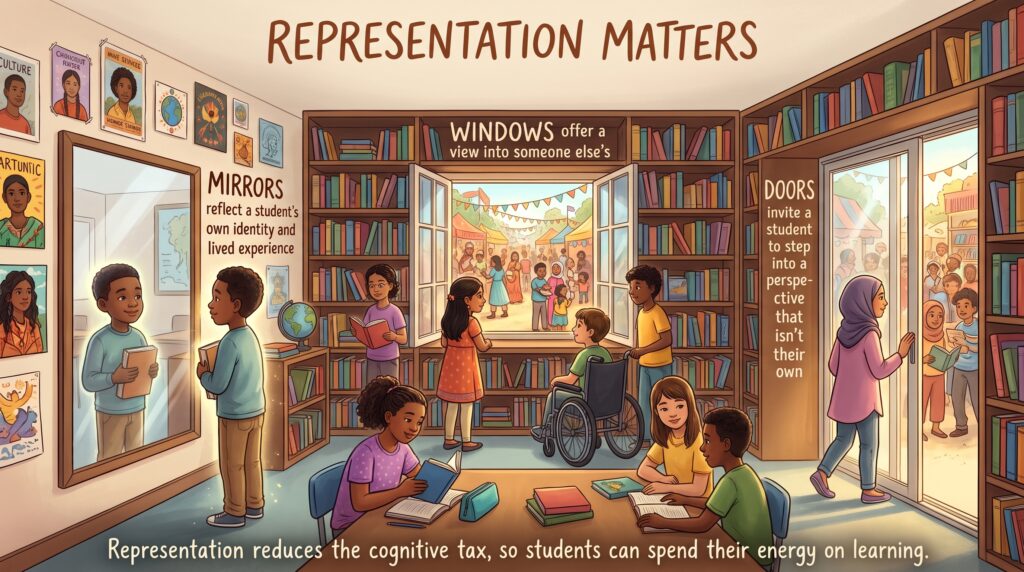
Representation matters! Mirrors reduce the cognitive tax, so students can spend their energy on learning instead of bracing for bias. Windows widen their view of a richly diverse world. Doors invite them to step through, using what they’ve learned from others to strengthen their own thinking. Every student deserves to see themselves in the classroom and school, and to experience perspectives beyond their own.
Ask yourself: Where does each student see themselves in my classroom, and where do they see someone who brings a different perspective? Does the instructional unit include more than one cultural viewpoint? Do I validate different ways of communicating and reasoning?
Relationships – Students learn more from teachers they trust. They take more intellectual risks when they feel known, and they persist longer when they believe someone genuinely has their back. Relationships among students matter too. Who gets included and who gets left on the margins isn’t random. It comes from the groupings, structures, and norms you set. Building connection into the school day, then making small deposits of trust in each interaction, lets you hold high expectations through which students can rise.
Ask yourself: Have I built regular moments into the day for students to share their thinking and interests? Do I set students up to succeed before putting them on the spot in front of their peers? How am I connecting with students’ families and their community?
Empowerment – Empowerment moves students from passengers to drivers of their own learning, from compliance to agency. Not every student arrives ready for that invitation, as some have learned that speaking up leads to consequences rather than change. Looking through this lens means offering real decisions to students: co-creating classroom norms, choosing a project topic, setting goals in student conferences, and selecting instructional activities.
Ask yourself: What decisions in my classroom could students make instead of me? Do students set and track their own learning goals? When a student asks a question, do I answer first or ask what they’ve tried?
Authenticity – Students spend much of the school day performing: answering the question they suspect the teacher wants, writing for an audience of one, completing the project for teacher review. Authenticity asks for a real audience, a real problem, and real solutions to questions no one already has the answers to. It also means students can bring their whole selves (their culture, humor, ways of speaking) without paying the price for it. Some students are quietly granted that permission while others learn to perform a safer version of themselves, one correction at a time.
Ask yourself: Which students get to be fully themselves here and which are performing? Do I invite students to connect the content to their own lives and communities? Who is the audience for student work beyond me?
Seeing More, Not Doing More
The Six Lenses of Instructional Equity are about seeing more, not adding another initiative to your plate. Start where you already succeed. Notice which lens comes most naturally to you. Then, choose one to look through more intentionally this month, in the lessons that you design and the conversations you facilitate.
Bishop, R. S. (1990). Mirrors, windows, and sliding glass doors. Perspectives: Choosing and Using Books for the Classroom, 6(3), ix–xi.
This post draws from the upcoming book Elevating Your Classroom Ecosystem: Creating the Conditions for Every Student to Thrive by Dr. Shané Beauford and Dr. Nancy Sulla. To explore the Six Lenses of Instructional Equity with your team, IDE Corp. offers virtual and on-site professional learning. Contact us at solutions@idecorp.com.