

By guest blogger Nicole Koch

The Power of Perseverance
Are our classrooms designed to make perseverance possible, or are we unintentionally rescuing students from the struggle that helps them grow?
Perseverance is not a personality trait students either have or lack. It is a skill, built through repeated opportunities to encounter challenge, experience temporary uncertainty, and remain engaged long enough to work through it.
As one of the 12 Durable Skills essential for future success, perseverance must be intentionally designed into classroom experiences. If students rarely encounter meaningful struggle, or if struggle is quickly removed, they have limited opportunities to develop the stamina, flexibility, and confidence required to persist.
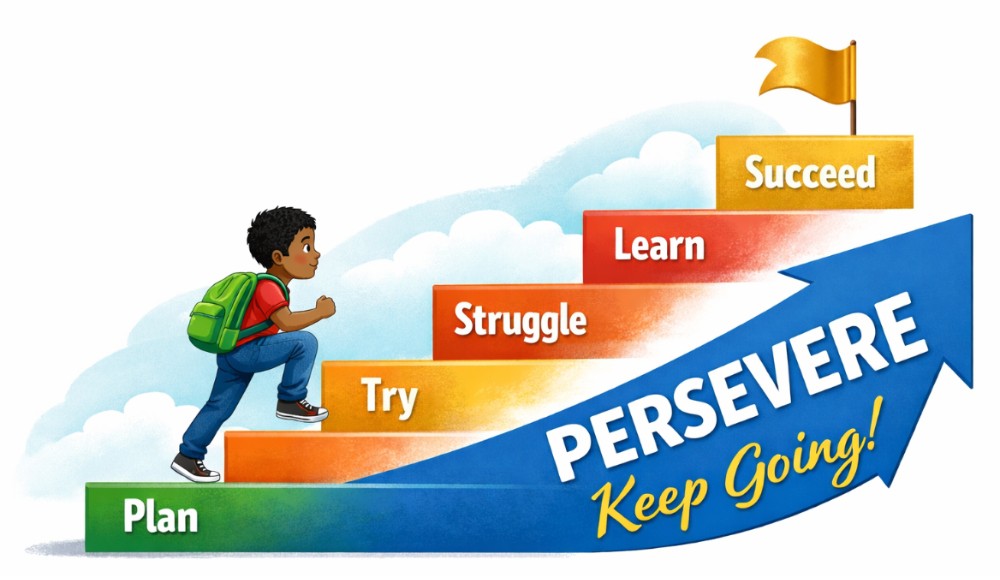
Five Steps to Building Perseverance into the Classroom Experience
Following is a set of steps to use in self-reflection, Professional Learning Communities, faculty meetings, post-observation conferences, and more. Here is a downloadable tool you can use as well!
Step 1: Design for Productive Struggle (The Learner Experience)
Rather than asking where students struggle, examine how struggle is built into the learning experience.
Look at your tasks and lessons. Ask:
✔️ Do tasks require students to think, decide, or problem-solve before being shown a specific method?
✔️ Are students expected to attempt before receiving clarification or correction?
✔️ Do tasks allow for more than one pathway, strategy, or approach?
✔️ Is the cognitive demand high enough that success is not immediate?
Actionable Moves
- Design tasks with a clear entry point and a stretch point.
- Delay models or worked examples until after students attempt.
- Use prompts such as:
- “Try two different ways before asking for help.”
- “What have you already tried?”
- Normalize difficulty by stating:
- “This task is meant to feel challenging at first.”
Step 2: Facilitate Without Removing the Struggle (Your Role as the Teacher)
Perseverance is often lost, not because students cannot continue, but because adults intervene too soon.
Examine your responses in moments of challenge:
✔️ Do I wait long enough before stepping in?
✔️ Am I solving the problem for students or supporting their thinking?
✔️ Do my prompts encourage independence or dependence?
Actionable Moves
- Use graduated support, not immediate rescue:
- Clarifying questions
- Strategic prompts
- Visual or procedural cues
- Direct instruction (only when necessary)
- Replace answers with prompts such as:
- “What part feels unclear?”
- “What’s one thing you could try next?”
- “Where did you get stuck?”
- Provide thinking time before allowing help requests.
- Signal trust in students’ capacity by saying:
- “I’m going to give you more time to work through this.”
Step 3: Make Perseverance Visible and Observable
If perseverance is never named or noticed, students may not recognize it as success.
Look for evidence beyond correct answers:
✔️ Students revising, retrying, or adjusting strategies
✔️ Students remaining engaged despite uncertainty
✔️ Students using resources independently
✔️ Students reflecting on mistakes without shutting down
Actionable Moves
- Publicly name perseverance:
- “I noticed you didn’t give up when the first strategy didn’t work.”
- Celebrate process, not speed:
- Revisions, drafts, iterations, retries
- Build reflection routines:
- What was hard?
- What helped you keep going?
- What will you try differently next time?
- Use anchor charts or visuals that define perseverance in student-friendly language.
Step 4: Strengthen Perseverance Through Structure and Routine
Perseverance grows when students know what to do when learning feels hard.
Consider your classroom systems:
✔️ Do students know what to do before asking for help?
✔️ Are struggle strategies explicitly taught and practiced?
✔️ Is perseverance embedded into routines, not reserved for special moments?
Actionable Moves
- Create a “When You’re Stuck” protocol (posted and practiced):
- Re-read the task.
- Try a different strategy.
- Use a resource.
- Ask a peer.
- Ask the teacher.
- Teach students how to self-talk through challenge.
- Build intentional wait time into lessons.
- Use checklists or progress markers to help students persist through longer tasks.
Step 5: Commit to One Intentional Shift
Perseverance does not develop overnight. Identify one small change to implement and observe.
Choose one:
- Delay intervention by 60–90 seconds.
- Add one open-ended task per week.
- Explicitly teach a perseverance strategy.
- Name perseverance daily during feedback.
Define your evidence:
- What will students do differently?
- What language will you listen for?
- How will you know perseverance is increasing over time?
Trust Students with Challenge
Perseverance is not built through encouragement alone. It develops when students are trusted with challenge, supported without rescue, and given repeated opportunities to work through difficulty with purpose.
When classrooms are designed to support productive struggle, students don’t just learn more; they learn how to keep going. This is a skill that will serve them well throughout their lives.
Perseverance is Supported by Executive Function – We Can Help!
All of the durable skills require the foundational skills of executive function. Perseverance involves the executive function skills of:
- – working toward a goal
- – initiating a task
- – persisting in a task
- – catching and correcting errors
- – monitoring performance
- – overcoming temptation
- – managing conflicting thoughts
Build a culture of executive function in your school by enrolling all of the school’s educators in our online, on-demand professional learning experience on “Executive Function: The Pathway to Student Achievement.”