

Student behavior can disrupt learning, but behavior itself is rarely the root issue. What educators are often witnessing in moments of challenge is dysregulation: a nervous system that has exceeded its current capacity to manage emotion, attention, sensory input, or cognitive demand. When dysregulation is treated as misbehavior, responses tend to focus on compliance. When it is understood through the lens of brain science and executive function, the focus shifts to skill development. Co-regulation is what makes that shift possible.
What Is Dysregulation?
Dysregulation occurs when a student is no longer able to access the executive function skills required to manage themselves within a learning environment. At that point, behavior becomes reactive rather than intentional. And while, to the person being hit by the book or crayon, it feels intentional, it most likely is not.
Dysregulation may look like:
- – Calling out, yelling, or crying
- – Leaving a seat or moving unsafely
- – Grabbing materials or pushing peers
- – Shutting down, avoiding tasks, or refusing to engage
- – Difficulty managing transitions or routines
These behaviors are not choices in the traditional sense. They are signals that the systems responsible for control and organization are temporarily unavailable.
The Physiology Behind Dysregulation
When a student becomes overwhelmed, the brain shifts into a stress response. The amygdala detects threat (real or perceived) and activates physiological systems designed for survival. Heart rate increases, muscles tense, and attention narrows.
At the same time, access to the prefrontal cortex decreases. This region of the brain supports executive function skills such as:
- – Thinking before acting
- – Attending and focusing
- – Holding information in mind
- – Shifting attention
- – Managing competing demands
When these skills are “offline,” students cannot self-regulate, regardless of how often they are reminded to do so.
Executive Function, Conscious Control, and Self-Regulation
Self-regulation is often described as a skill, but within an executive function framework, it is more accurately understood as an outcome.
Self-regulation is what we observe when executive function skills, particularly those that support Conscious Control, are working together effectively.
In this framework:
- Conscious Control is the executive function engine that makes regulation possible.
- Self-Regulation is the visible expression of that engine in action.
When students are regulated, they are thinking before acting, managing impulses, focusing attention, and responding intentionally. When they are dysregulated, conscious control is unavailable.
This distinction matters because it shifts the instructional question from “How do we get students to self-regulate?” to “How do we build the executive function skills that make self-regulation possible?”
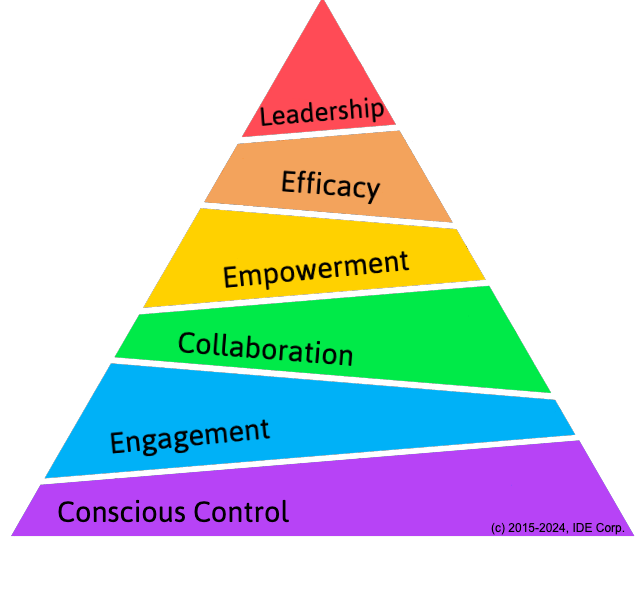
Building Conscious Control Skills Through Co-Regulation
Executive function develops from the outside in. From birth, human beings develop the prefrontal cortex and, thus, executive function skills, through interaction with the outside world. Students cannot independently manage skills they have not yet internalized. The good news is that the prefrontal cortex responds to intentional strategies to build executive function.
Co-regulation is the process by which an adult temporarily provides the structure, cues, and calm that a student’s developing brain cannot yet supply on its own. Through repeated experiences of co-regulation, students gradually internalize these supports so that they can self-regulate.
Co-regulation:
- – Reduces cognitive and emotional load
- – Keeps demands within the student’s capacity
- – Models calm, organized responses
- – Supports the gradual development of conscious control
Co-Regulation Cards: Making Conscious Control Visible
One practical way to support co-regulation—especially for students with language, attention, or processing challenges—is through visual co-regulation cards.
These cards:
- – Externalize expectations so they do not have to be held in working memory
- – Reduce verbal demands during moments of stress
- – Provide consistent cues across adults and settings
- – Support dignity by allowing quiet, nonverbal intervention
Below is an example of three co-regulation cards: one for breakfast time, one that applies to any situation, and one for small-group participation. (Download a printable collection here.)
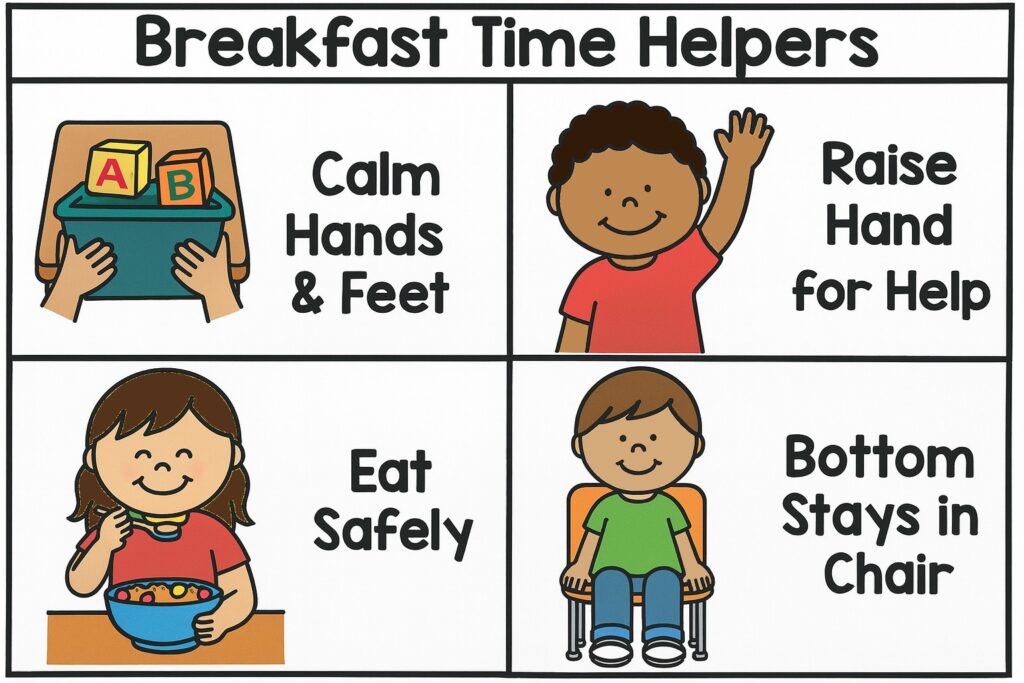

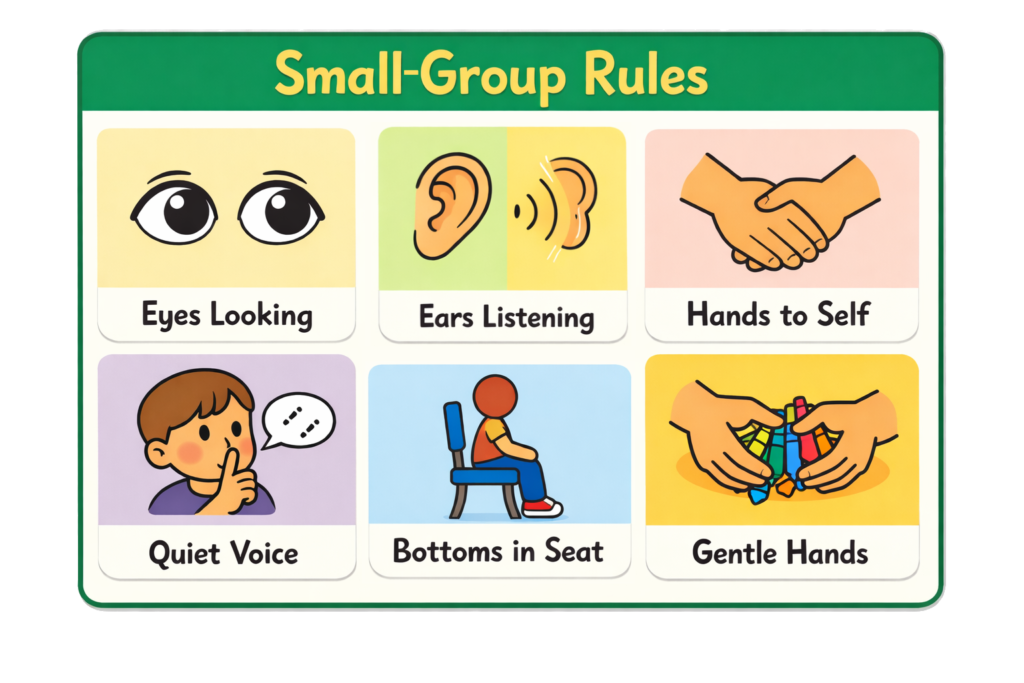
How Adults Use Co-Regulation Cards: A Gradual Release of Conscious Control
The power of co-regulation cards lies in how they are used over time.
Phase 1: Adult-Led Co-Regulation
An adult gently touches the student’s shoulder and points to the relevant image. Language is minimal and neutral.
Phase 2: Visual Prompting
The adult points to the card without physical contact. The visual cue carries the message.
Phase 3: Student Identification
Sensing dysregulation, the adult asks, “Which one do you need to work on right now?” The student points to the behavior, and the adult acknowledges that with a positive comment or nod.
Phase 4: Self-Initiation
The student independently references the card and adjusts behavior without prompting.
At each phase, the adult is gradually releasing conscious control to the student.
Why This Works
Students with dysregulation often experience challenges across multiple executive function domains. In moments of dysregulation, verbal corrections increase cognitive load and escalate stress.
Visual co-regulation tools:
- – Support Conscious Control by narrowing attention, positioning students for academic learning
- – Reduce demands on working memory, increasing the probability of success for the student
- – Increase predictability and emotional safety: key requirements for the shift to self-regulation
- – Allow multiple adults to cue behavior consistently, engaging all adults rather than waiting for another to take action
Importantly, these tools are not consequences or corrections. They are instructional supports.
Let’s help students build executive function skills for self-regulation and academic achievement!
IDE Corp. Offers Consulting and Professional Learning to Support Specially-Designed Instruction
Consider building a culture of professional learning by enrolling all educators in a school in our online, on-demand professional learning experience on Executive Function: The Pathway to Student Achievement. Twelve content modules, packed with video, text, images, examples, downloadable tools, insight videos, reflections, and more, allow you to engage through faculty meetings, PLCs, PD days, study groups, individual resource exploration, and more. Visit learn.edquiddity.com.
Looking for an individual professional learning opportunity? Join a Virtual Learning Community: five-week online engagement with a consultant and other educators, offering flexible time engagement. We offer several topics related to executive function. Visit edquiddity.com/VLC.