

Teachers Change Students’ Lives
AI can deliver a lesson; it can grade an essay; it can personalize a quiz. But there’s a growing list of actions it simply cannot do, and most of them are the things that actually change a student’s life.
Think about it: Most of what we refer to as “teaching” is really just content delivery. Explaining photosynthesis, walking through long division, explaining figurative language, introducing letter sounds. And for that kind of teaching? AI is genuinely, impressively good.
It’s patient; it’s available at 2 a.m.; it adjusts to a student’s pace without getting frustrated; it never has a bad day. If content delivery were the point of teaching, teachers would be unnecessary. But content delivery was never really the point of the teaching profession.
The point of teaching has always been something far bigger: to prepare young people for their lives and careers ahead. To build thoughtful, capable citizens. To change the trajectory of a human being. The only reason teachers spent so much time delivering content was because there were few other ways to give students access. The teacher at the front of the room was, for a very long time, the most efficient technology available.
That’s no longer true. The possibilities for content delivery are now virtually limitless, and that shouldn’t threaten the teaching profession. It should free it. Free it to become what it was always meant to be, before the constraints of scarcity made content delivery the default. Free it to do the work that actually changes students’ lives.
“People will forget what you said, people will forget what you did, but people will never forget how you made them feel.” — Maya Angelou
That’s the real work of teaching. And it was always the real work. AI has just made the case for it more urgent, and more possible.
What AI Is Actually Replacing
When teachers are anxious about AI, they’re often anxious about the wrong thing. They’re defending their role as content expert: the person who knows the material and transfers it to students. That role? It’s already been disrupted. A student with a smartphone has access to more knowledge than any single teacher could ever hold.
The real question isn’t whether AI can teach content. It’s whether content was ever where a teacher’s value lived.
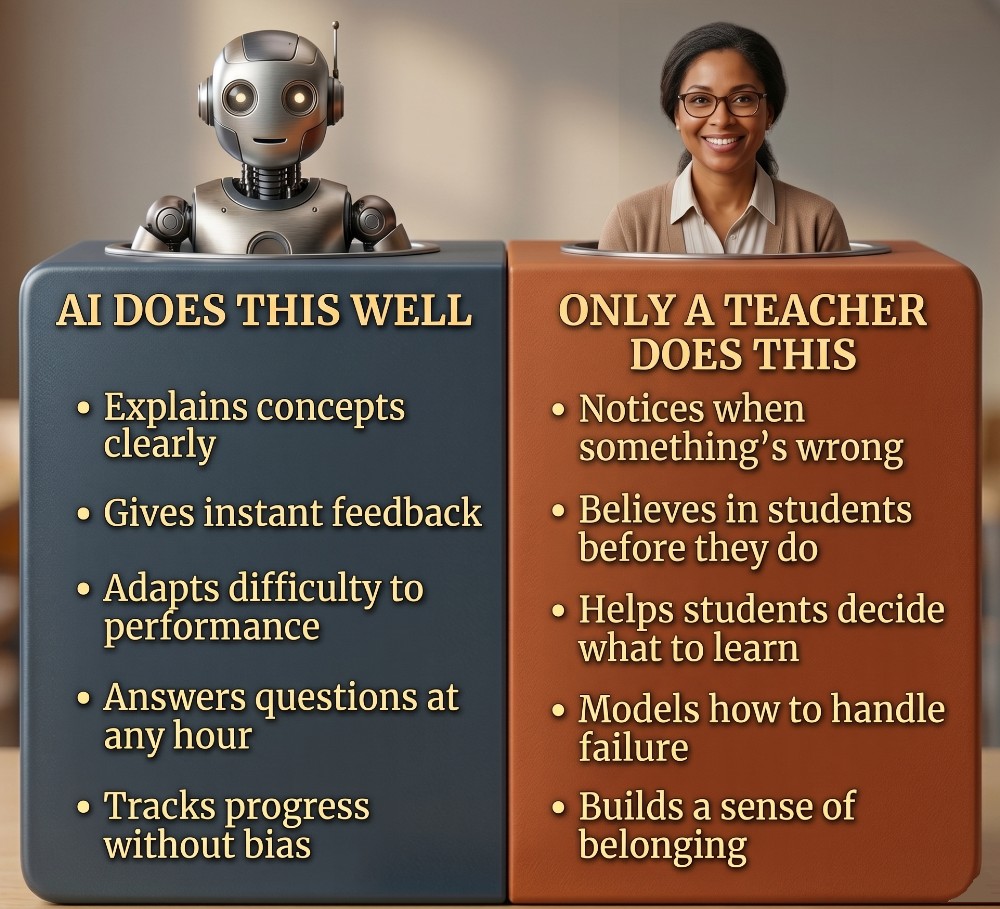
The Four Things Only Teachers Can Do
When you strip away content delivery, what’s left? Quite a lot, it turns out. These are the capacities that matter most, and that no AI, however sophisticated, can replicate, because replicating them would require something AI fundamentally lacks: the ability to truly know another person, not just their words.
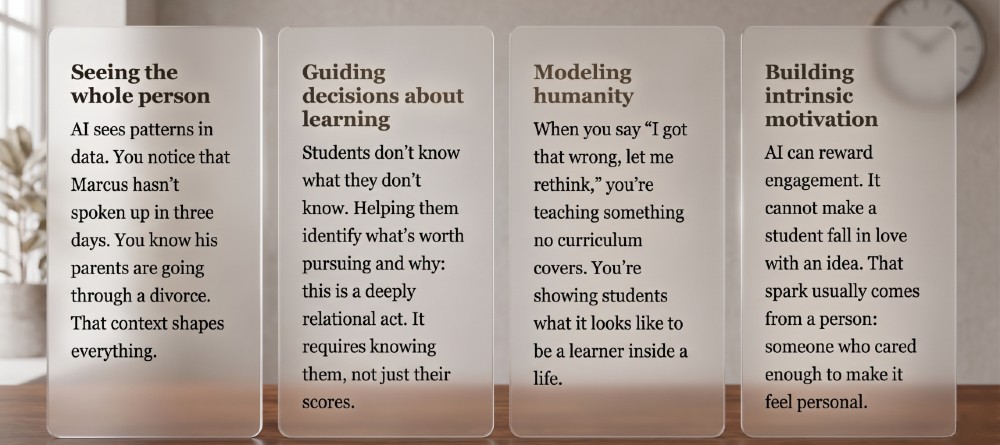
The Shift Worth Making
The most forward-looking teachers are already making a quiet but significant move: They’re outsourcing content to AI so they can invest more time in the things only they can do. They’re using AI to handle the first explanation, the basic drill, and the initial essay feedback, and freeing themselves up for the conversation that follows.
That conversation is where the real teaching happens. What did you find hard about this? What would you want to learn next? What does this remind you of in your own life? These questions don’t have a right answer. They require a human on both ends of the exchange. And while AI can generate questions like those, it lacks the human edge to make a difference in the student’s life with the answer. AI doesn’t wonder about your student at 6 p.m. It doesn’t notice her in the hallway the next morning and ask how things are going. It doesn’t feel the pause before she answers. When AI expresses understanding, it is returning a reflection of what caring looks like in language, without the lived experience behind it.
A Practical Starting Point
If you want to experiment with this shift, start small: Pick one unit where you currently spend most of your time explaining content. Hand that part to an AI tool, a video, a reading. Use the time you free up to be present with your students in the ways only you can: noticing who’s disengaged, who’s struggling beneath the surface, who is bored because they’ve mastered the work, who needs to build executive function skills to understand the content, who needs someone to believe in them today, who has something happening at home that’s interfering with concentration. That’s not a conversation AI can have; it’s a relationship only a human can build.
You’ll likely find that those conversations change something. Students become more invested. You become more present. The classroom starts to feel less like a place where content is distributed and more like a place where people figure things out together.
That’s always been what great teaching looks like. AI just makes the case for it more urgent, and more possible.
Looking to leverage AI in your school? IDE Corp. can help! With consulting; workshops; Virtual Learning Communities (VLCs); and school-wide, on-demand Professional Learning Experiences (PLEs.)