

IDE Corp.’s Director of Learning Design
Dysregulation happens! . . . to everyone. It is an autonomic nervous system response to the question: Am I safe right now? It moves faster than the thinking brain because its role is protection, not reasoning. Stress can compound this response, and by the time the school day begins, every person in the building already has a nervous system in motion.
Your autonomic nervous system has two primary branches:
The sympathetic nervous system is your “fight or flight” response. It increases alertness, energy, and focus. But when it is overstimulated, the brain prioritizes survival over reasoning, and access to higher-level thinking decreases.
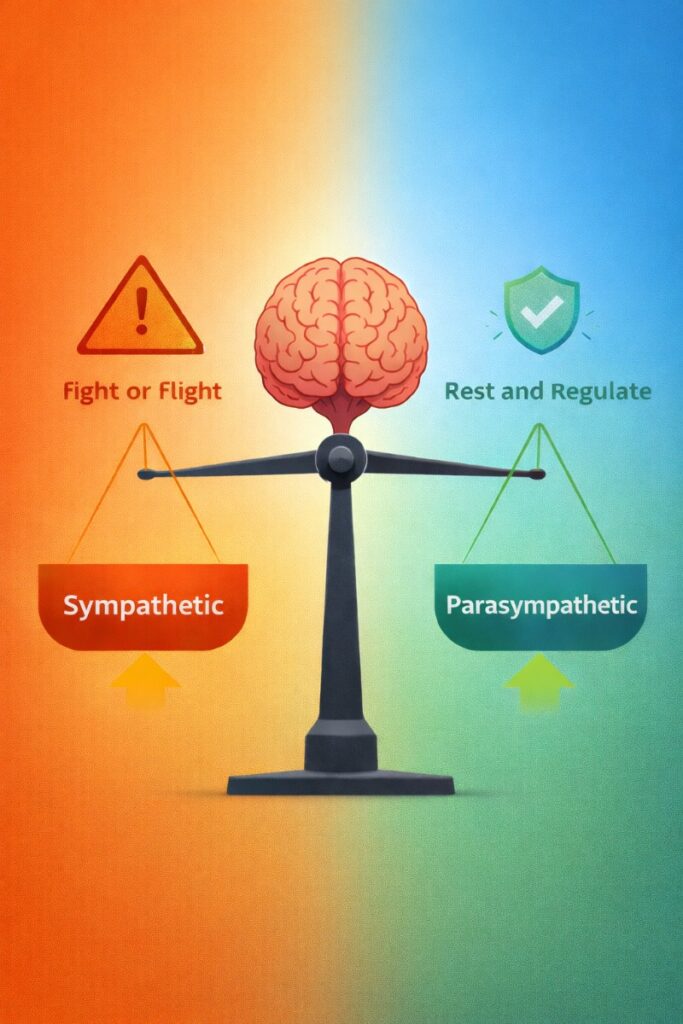
The parasympathetic nervous system is your “rest and regulate” system. It restores calm, supports recovery, and creates the sense of safety the thinking brain requires.
These systems are not opponents. They are dynamic, continuously adjusting in response to experience. All humans move between these systems. Students with regulation-related disabilities experience these shifts more frequently, more intensely, or with greater difficulty returning to baseline. Although we cannot remove all stress from a school day, we can create the conditions that make learning possible.
Dysregulation is not defiance. It’s physiology.
As educators, you walk into the school day with your own internal state.
Your students walk in with theirs.

If students become dysregulated, teachers can help them regulate through co-regulation strategies.
Co-regulation is one regulated nervous system helping another return to baseline. It is the intentional use of tone, pacing, body language, predictability, and presence to create enough safety for the thinking brain to come back online.
Co-regulation is not rescuing. It is not lowering expectations or removing accountability. It is providing the external stability the nervous system needs in order to settle so that expectations and accountability can be accessed. Those signals communicate to the brain: You are safe. You can stand down.
When a student becomes dysregulated, it’s normal for an adult in the room to feel:
- • Frustration
- • Embarrassment
- • Irritation
- • The thought: “They’re doing this on purpose.”
- • Or: “They know better.”
Those feelings are real. And they are signals that our own sympathetic nervous system is now activating.
The moment we interpret a student’s dysregulation as intentional, ours escalates. Tone tightens. Pace increases. Control replaces regulation. Two survival systems collide, and thinking shuts down.
So the most important question is not, “What is the student doing?” It is, “What am I doing in response?” Because we cannot regulate a student when we are in a dysregulated state.
If the stress response is automatic, logic alone will not reverse it. A dysregulated brain does not respond to lectures, consequences, or raised voices. It responds to cues of safety, routine, and structure that reduce unpredictability. (See our co-regulation cards.)
Taking the emotion out of dysregulation does not mean ignoring what we feel. It means recognizing that activation and regulating ourselves first. When we remember that dysregulation is automatic, we create space between trigger and response. And in that space, we choose strategy.
When the adult regulates first, the classroom stabilizes.
When the classroom stabilizes, thinking returns.
When thinking returns, learning becomes possible.
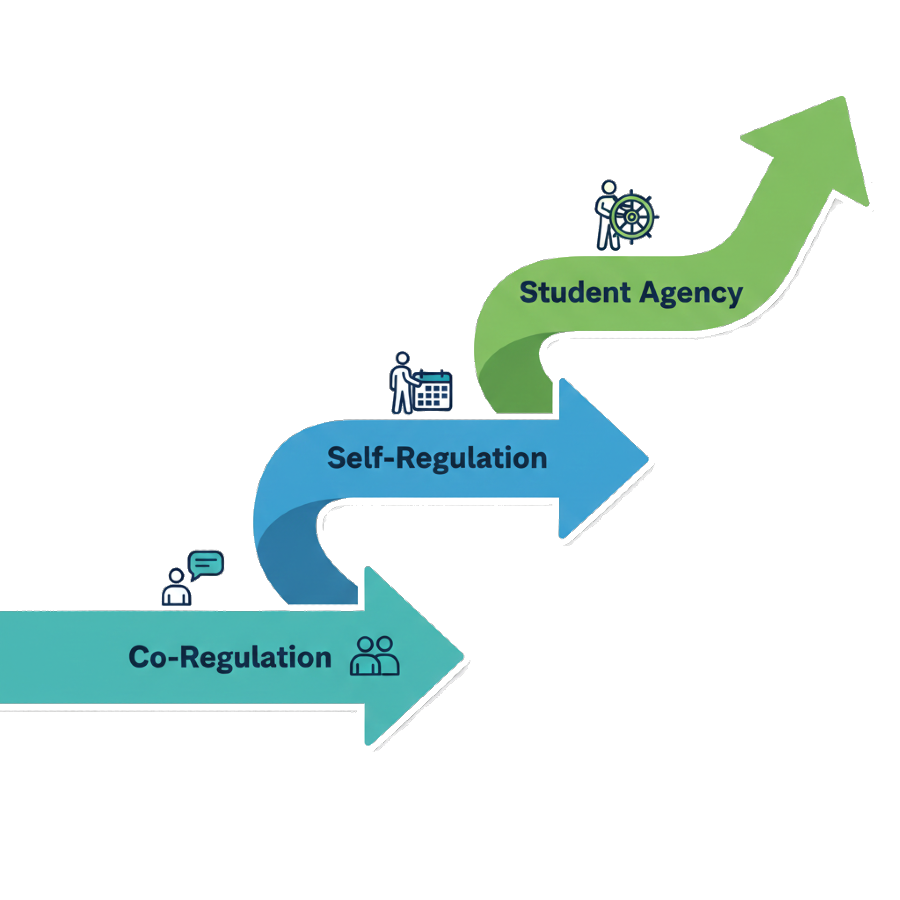
Know, too, that the goal of co-regulation is not dependence. It is building the internal capacity for self-regulation over time.
Self-regulation is the gateway to executive function. Without safety, students cannot access working memory, flexible thinking, or self-control. Co-regulation is not separate from academic learning; it is the condition that makes executive function possible.
Download our Predictability and Safety Design Audit.
IDE Corp. consultants — all experienced educators — partner with schools to address issues related to academic achievement and social, emotional, and mental wellness.
Consider our online, on-demand Professional Learning Experience in Executive Function: The Pathway to Student Achievement. Check out a one-minute video by Dr. Shané Beauford, our VP of Learning Design & Equity.
For more solutions — in person, remote, and virtual — contact Nicole (Nik) Koch at solutions@idecorp.com or 201-934-5005.